
Jason Fitzpatrick
Residential and Commercial Real Estate Broker
Mobile: 514.824.9181
Phone: 514.694.2121
By Pearl Kezele & Jason Fitzpatrick (Team Kezele), Royal LePage Village
Wednesday, October 28, the Bank of Canada announces its next policy rate decision and this post is deliberately written two days early, because the honest answer right now is that nobody knows the outcome yet. Markets price roughly a 75-85% chance of a quarter-point hike, but bank economists are split, and the Bank itself has not signalled a direction. A market bet is not a decision. So instead of predicting Wednesday, here is what Wednesday means for you either way.
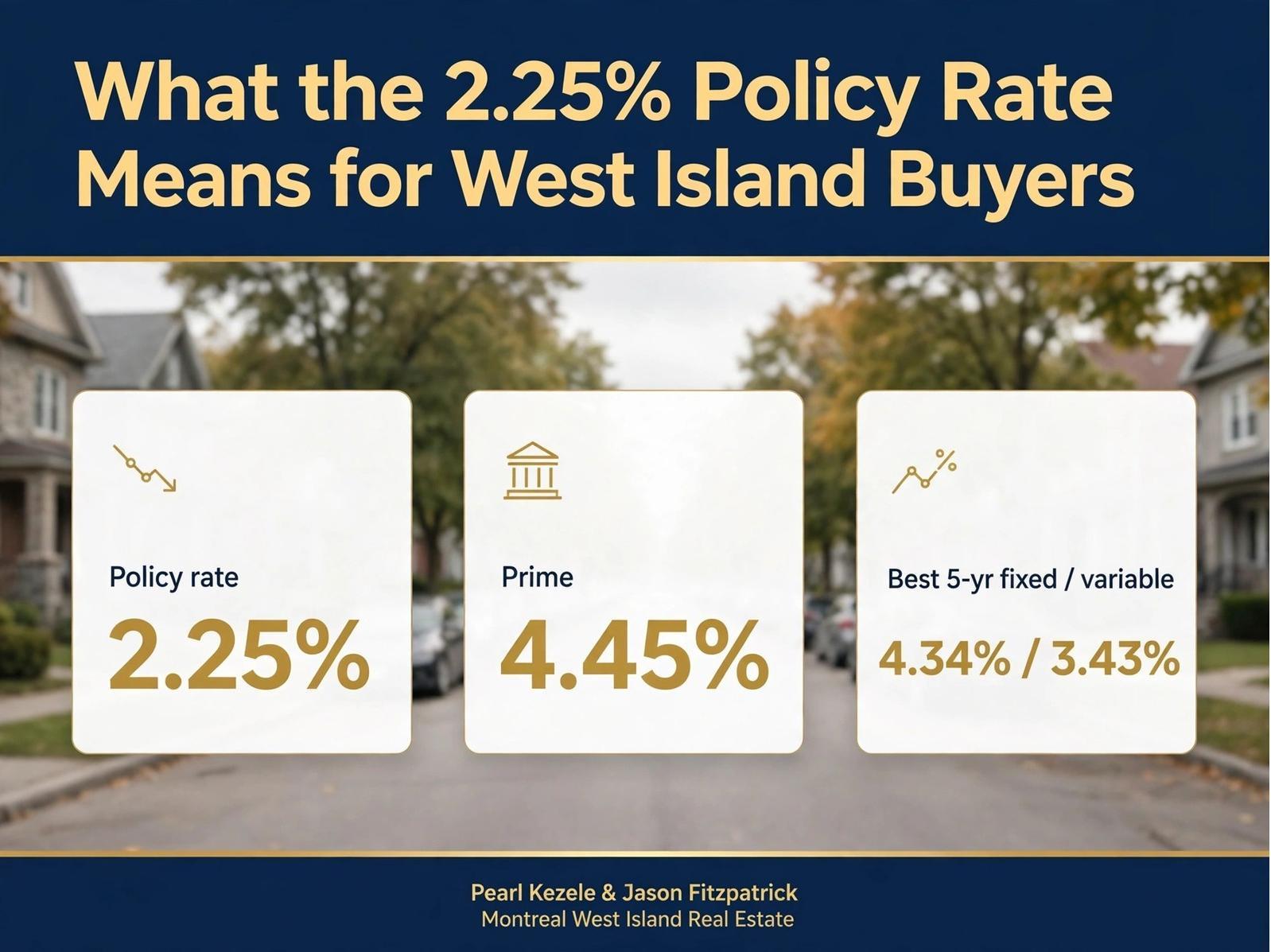
First, where things stand today. The Bank's policy rate is 2.25%, unchanged since October 2025—seven straight holds. Big-bank prime sits at 4.45%. The best insured five-year fixed rate is about 4.34%, and the best five-year variable is about 3.43%. September inflation came in at 3.1%, above the Bank's 2% target.
Here is the mechanic most buyers miss, and it is the real story behind the headline rate. The policy rate is just the headline; the yield curve is the machine. Prime hangs off the policy rate, so prime is what variable mortgages actually feel—the pipe into your monthly payment. Fixed rates hang off the middle of the curve, which moves on its own. That is why fixed rates have already drifted up on rising bond yields while the Bank sat still: fixed priced in this hike weeks ago. It is, frankly, plain complicated: monetary policy pulling tight while government spending stays loose.
Now the two branches. If the Bank holds on Wednesday, variable payments do not change: prime stays at 4.45%. If it hikes a quarter point, prime moves to about 4.70% within days, and variable payments move with it. On a typical West Island file—an $800,000 purchase, 20% down, a $640,000 mortgage over 25 years—the numbers are concrete. At today's best variable rate of 3.43%, the payment is about $3,180 a month. At today's best fixed rate of 4.34%, it is about $3,499. The certainty premium is roughly $319 a month, or about $3,830 a year. A quarter-point hike would add roughly $86 a month to the variable payment. Run the number before Wednesday, not after.
Central banks create the game everyone else plays, and right now policymakers are repeating the Q4 2022 playbook: tightening into a softening economy. Buyers retreat, sellers hold, volume dies, prices stay sticky. September's national numbers show it in print—sales down 2.3% from August, yet prices easing only slightly, with 4.9 months of inventory: balanced on paper, drifting toward buyers. Pearl has guided West Island families through multiple cycles like this since 1984, back when this was still called the Lakeshore, and this phase has a recognizable shape. Not a crash. A reset.
For buyers: The variable discount—about $319 a month on a typical West Island file—is real money, but it is a bet on the Bank, and Wednesday the bet gets priced. If you are buying or renewing within 120 days, get a rate hold now; it usually costs nothing, and it protects you if rates rise. Budget at the fixed rate, buy at the variable. And hold the asset-holder truth in mind: the payment is temporary, but a well-bought West Island asset compounds for decades. One Canadian caveat to keep, not skip: that "debt shrinks in real terms" superpower reprices every five years here, not thirty.
For sellers: Every quarter point reprices your buyer pool's purchasing power. The quiet supply story is the renewal wave: Royal LePage's 2026 survey found 38% of renewing homeowners expect their payment to rise, and of those, 76% say it will strain household finances. Those are not foreclosures, but that slow bleed turns "wait for spring" sellers into motivated sellers by February. Price on today's data, not last spring's, and price for the buyer pool that exists after Wednesday, not the one you wish existed.
At Montreal West Island Real Estate, we read the cycle so you do not have to guess at it: prepare now, decide with numbers, and move when the right home appears.
Curious what your West Island home could sell for? Ask Pearl & Jason for a free, no-obligation valuation:
https://montrealwestislandrealestate.ca/home-valuation
Pearl Kezele & Jason Fitzpatrick (Team Kezele), Royal LePage Village. Pearl brings 42+ years of West Island real estate experience.
Sources: Bank of Canada policy rate 2.25% and prime 4.45% (Bank of Canada; nesto prime-rate page, October 2026); best insured five-year fixed 4.34% and variable 3.43% (Ratehub, October 26, 2026); September CPI 3.1% (Statistics Canada); CREA September 2026 national statistics (sales -2.3% month over month; 4.9 months of inventory); Royal LePage 2026 Mortgage Renewal Survey (August 19, 2026); hike odds from overnight-index-swap pricing via Reuters/LSEG and the Reuters economist poll (October 21-23, 2026). Payment figures are illustrative, based on a $640,000 mortgage over 25 years; actual rates depend on your file.
What the 2.25% Policy Rate Means for West Island Buyers | Pearl Kezele & Jason Fitzpatrick
The Bank of Canada decides October 28. With the policy rate at 2.25% and prime at 4.45%, here's what a hold or a hike means for West Island buyers and sellers in plain language.
Copyright© 2026 Jumptools® Inc. Real Estate Websites for Agents and Brokers